House pads and site prep in Dalton and Whitfield County
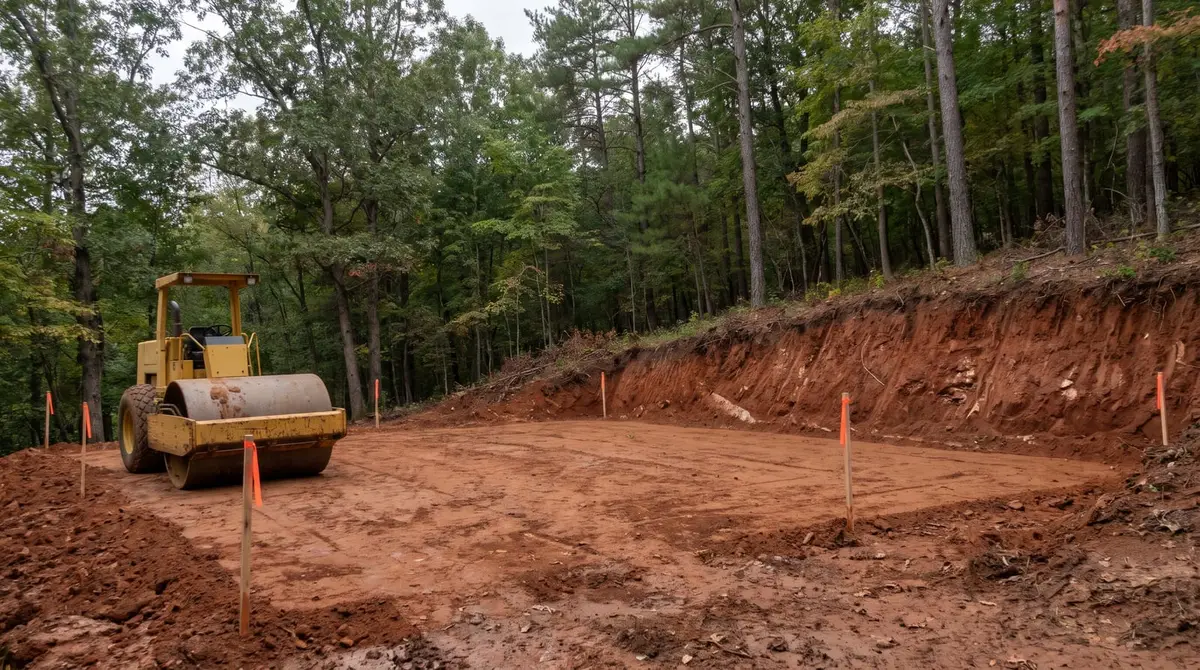
Before a foundation goes in, the lot needs a flat, firm pad and a plan for where water will go. On the sloped lots common around Dalton, that usually means cutting soil from the high side and filling the low side in thin, compacted layers.
Call (706) 229-7411Rather not call? Send the detailsCalls are answered weekdays, 9 to 6. After hours, leave your name, address and what's going on, and you'll get a call back first thing the next business day.
What does site prep for a new house include?
- Clear: Trees, brush, stumps and topsoil come off the building area and the driveway route.
- Cut and fill: Soil is moved from high ground to low ground to make a level pad at the planned height.
- Compact in layers: Fill goes down in thin lifts, each compacted before the next, so the pad does not settle under the house.
- Set drainage: The pad sits a little above the ground around it, and the finished grade falls away on every side.
- Rough-in access: A gravel construction entrance and drive let trucks reach the site without tracking mud onto the road.
Why does compaction matter so much?
Loose fill keeps settling for months or years. Under a house, that shows up as cracks in slabs, sticking doors and sagging porches. Placing fill in thin layers and compacting each one is slower, but it is the difference between a pad that holds and one that sinks.
Your builder or engineer may specify how the pad is compacted and tested. Share those notes with the grading crew before work starts.
Do I need a land-disturbance permit to build?
In Whitfield County, a land-disturbance permit is required when work disturbs more than an acre, is inside a subdivision developed after 2000, or comes within 200 feet of a year-round stream. Many new-home lots in newer subdivisions fall under that second rule.
The same county page lists exemptions, including construction of a single-family home that is not part of a larger project, as long as the work meets the state's minimum requirements. Whitfield County handles stormwater rules for the unincorporated county and for Dalton, Varnell and Tunnel Hill, so check with the county engineering office for your lot before work begins.
How much does site prep cost?
As a rough guide for 2026, HomeGuide's national excavation figures put a foundation pad for a new home site at $1,500 to $10,000, with general excavation at about $2.50 to $15 a cubic yard of soil moved. Clearing, hauling dirt in or out, rock and steep slopes add to it.
Ask for clearing, pad work, the construction entrance and any hauling as separate lines.
Common questions
How long does a house pad take?
Often a few days on an open lot, longer with heavy clearing, rock or a lot of fill. Rain can stop work for days.
Who should I hire first, the builder or the grader?
Usually the builder or a surveyor sets the house location and pad height first, then the grading crew builds to it.
What if my lot has rock?
Rock slows digging and can need a bigger machine or a breaker. Ask whether the quote covers rock or charges extra if it turns up.
Sources: Whitfield County Engineering, Land disturbance: what requires a permit (source); Whitfield County, Stormwater and erosion control (source); International Residential Code 2024, R401.3 Drainage (adopted in Georgia with amendments) (source); HomeGuide, Excavation cost (Feb 2026) (source).
Last reviewed October 31, 2026.
Rather not call? Send the details
A local grading pro will call you back.